The challenge
When I arrived there was no clear or consistent product discovery process. Each area worked from isolated information, and decisions were driven more by intuition than by data or evidence. The challenge was to design and roll out a continuous, collaborative and structured discovery framework that would: align practices across teams (UX, PM, Tech, advisors); produce actionable weekly insights; give traceability from evidence through to learnings, insights, hypotheses and experiments; and be sustainable over time rather than depending on one-off efforts.
Process
Research
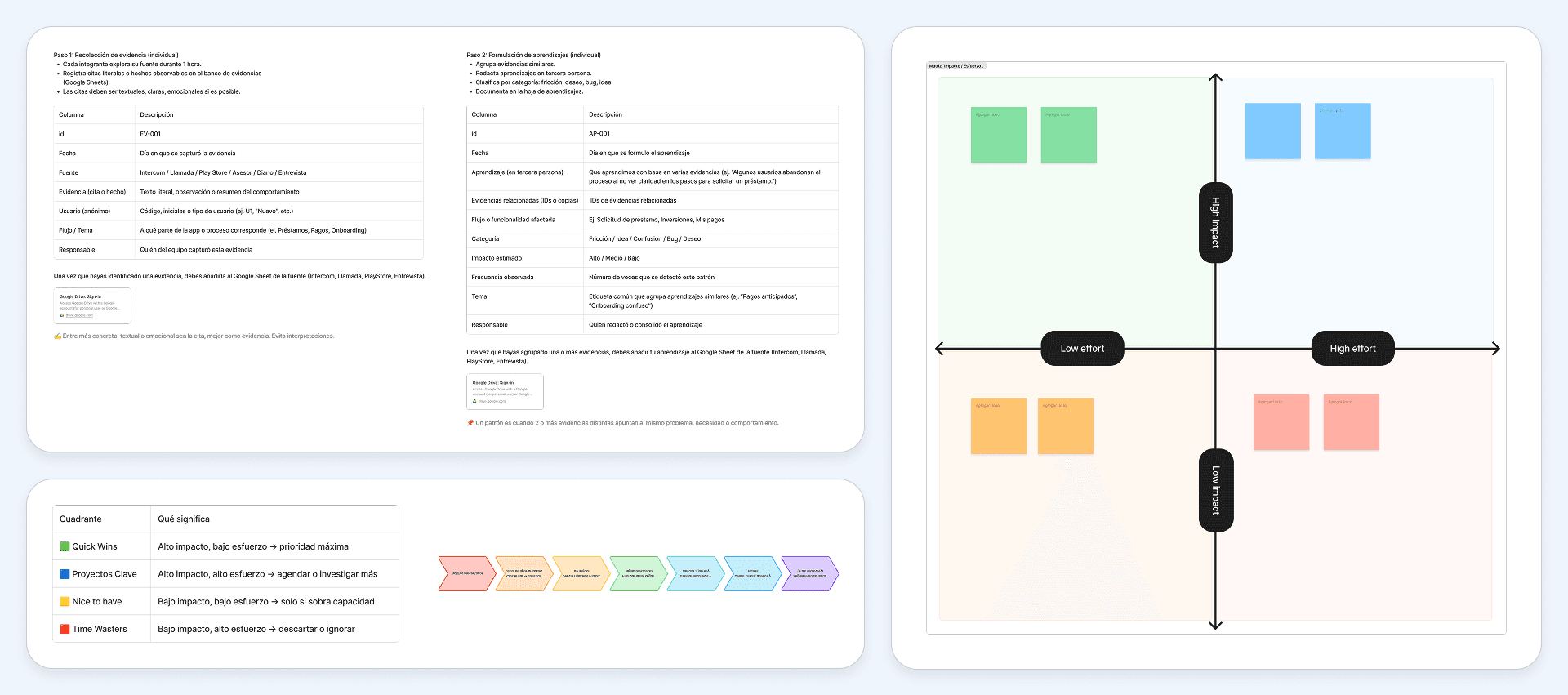
I rolled out the framework by presenting its core principles: continuous discovery, the UX/PM/Tech product trio, and visualisation through an Opportunity Solution Tree. I ran a walkthrough of the opportunity tree and of the templates for evidence, learnings and insights, and assigned sources and owners.
Design
I defined a structured working rhythm. Weekly: each member analyses one source (Intercom, calls, reviews, interviews) and documents evidence and learnings, and on Fridays we hold a synthesis and prioritisation meeting. Monthly: we choose a desired outcome, for example improving conversion, and update the tree. Quarterly: I present a Discovery Digest with key insights, prioritised opportunities, experiments run and roadmap adjustments.
Development / Automation
I chose the tools and the way we collaborate: Google Sheets for structured, traceable documentation, FigJam and Miro to visualise the tree, and Figma and Google Meet to validate prototypes. I brought advisors in as discovery champions to share findings, and added PM and Tech to the monthly reviews so prioritised insights feed roadmap decisions.
Role and tools
Role
- Framework definition
- Session facilitation
- Opportunity Solution Tree
- Synthesis and prioritisation
- Quarterly Discovery Digest
Tools
- Google Sheets
- FigJam
- Figma
- Google Meet
Outcomes
- A continuous discovery rhythm established, no longer dependent on isolated projects
- Cross-functional alignment with genuine participation from UX, PM and Tech
- Living, traceable documentation from evidence to learnings to insights to hypotheses to experiments
- First A/B and usability experiments launched from prioritised insights
What I learned
The value of discovery is not in accumulating findings, but in turning them into prioritised opportunities that steer the roadmap. Traceability is essential: every insight has to be traceable back to the original evidence. Involving each area from the start is what secures adoption of the process. Discovery does not pause: it takes weekly consistency and discipline.