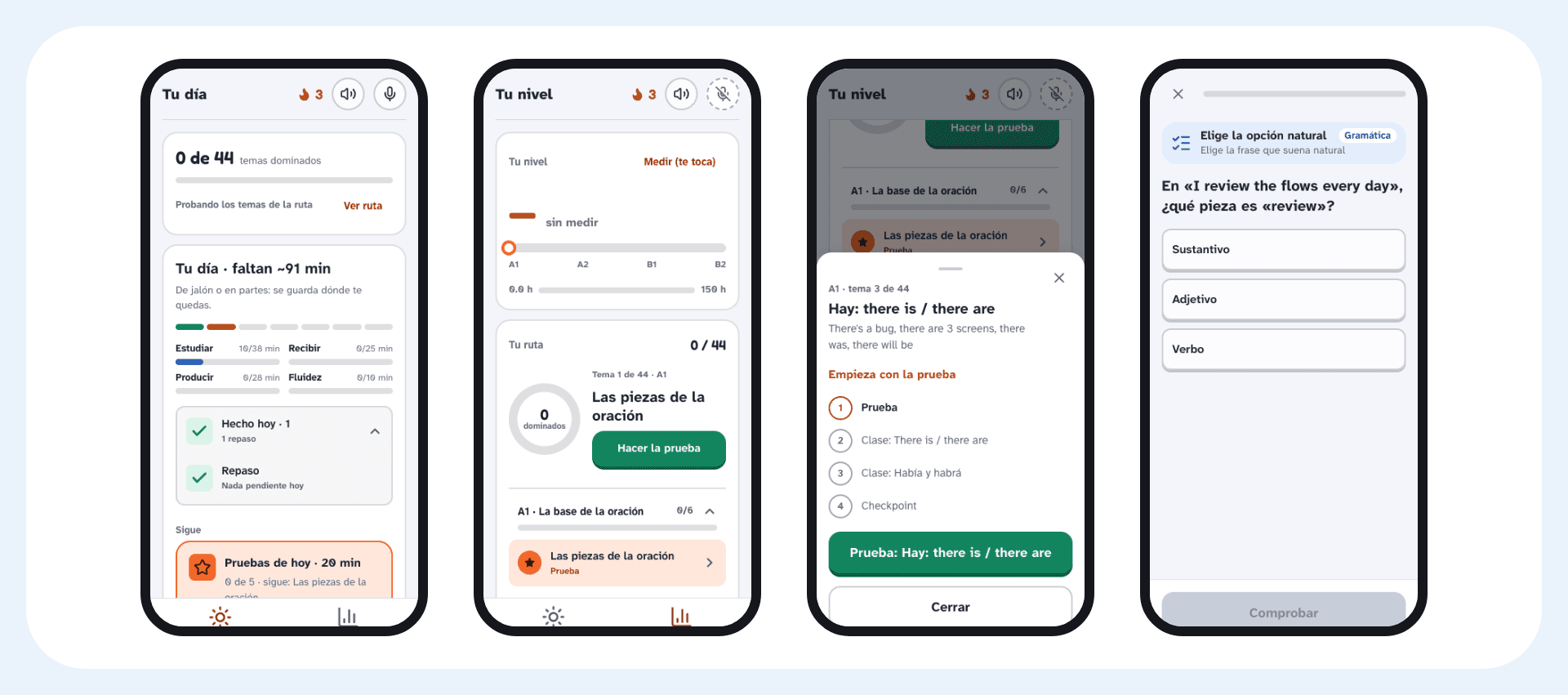
The challenge
I need English for interviews and remote work by January 2027, mostly for speaking in stand-ups, design reviews and calls. I wanted something like Duolingo, built around the situations I actually face at work. I'm the only user, so the data is very detailed and only speaks about me. It doesn't prove the app would work for anyone else.
Process
Research
The app started out assuming I was at B1. Three weeks later I took a level assessment and scored A2+, which meant I had been practicing one level above my own the whole time. Those 23 days and 56 hours of use also revealed my main problem. I can use auxiliary verbs in writing, but they disappear when I speak. On a call I'd say "I share the usability test by Thursday," with no will. More explanation wasn't going to fix that. I needed to practice speaking under time pressure.
Design
With that data, I rebuilt the plan from scratch. The path became 44 topics in the order of Cambridge's English Grammar Profile, and each one opens with a test, followed by a lesson and a checkpoint. I saw that about 60% of my time went to studying the language and about 1% to hearing or reading English I could understand, while Nation's model splits it into four equal parts. Now every step of the day belongs to one part, and a bar shows how I'm doing. I also let my complaints as a user carry weight. "I feel like I'm not making progress" became "Today's tests," and I cut the app down to two tabs so there would be a single path.
Development / Automation
It began as a Claude artifact, and on October 19 I moved it to Vercel, with Supabase for progress and Whisper to transcribe my voice. I built it with Claude Code, with more than 220 commits in 16 days. I'm now migrating it to a new app in Next.js and TypeScript, with tokens and components in Storybook, while I keep using the old one every day.
Data analysis
One exercise explained the passive voice before I had studied it, so I asked for a full audit. About 1 in 6 saved errors flagged something correct as wrong or taught a false rule. Those corrections went into my review queue, and the AI generated more exercises from them. I tested the grader with 60 sentences, half correct and half with real errors, and used the results to choose the model and the prompt. Now a second model has to confirm before anything counts as an error. Every week a bot reads my data and proposes changes with the evidence and the cost, and I decide which ones to apply.
Role and tools
Role
- Product design
- Development
- Data analysis
- Design system
- Test user
Tools
- Claude Code
- Next.js
- TypeScript
- Storybook
- Supabase
- Whisper
- Vercel
Outcomes
- The A2+ result changed the starting point, and the path was rebuilt for that level
- In the 60-sentence test, correct sentences flagged as errors fell from 20% to 0%, and the new grader missed 2% of the real errors
- I removed 29 of 150 saved errors and 28 of 200 generated exercises that taught something wrong
- The full audit found 50 serious problems and 108 minor ones, and almost all the serious ones were in AI-generated content
- It costs about $10 a month, measured in November
- There's no second level assessment yet, so I can't say how much I've improved
What I learned
What AI generates shouldn't go straight to someone who's learning. A grader's mistake repeats in the review queue and multiplies into new exercises, and the learner has no way to notice. I also learned to distrust myself as a user. I asked for things that didn't help me learn, and once I had to complain, "you should have told me no." Now every teaching decision states whether it comes from a study or from my own judgment.